Monday, March 10, 2014

Horror Film countdown 2013, part 7


Dracula (1931), dir. Tod Browning, Universal Pictures


Considered by some to be the first ‘proper’ Universal Horror film, or at least the first to establish some popular elements of the genre, the film was a landmark when it opened in 1931. The first vampire film with sound set the tone for many other bloodsuckers to follow.
 
We open with real estate agent Renfield (Dwight Frye) bouncing along in a horse driven coach in the Carpathian Mountains. When the coach stops at a local inn, Renfield horrifies the innkeeper when he mentions his final destination. The utterance of the words “Castle Dracula” sends the innkeeper and the guests into a panic, which Renfield dismisses as superstition.
Meanwhile, at Castle Dracula, Count Dracula (Bela Lugosi), his brides, along with the rare Transylvanian armadillo and bumblebee wake from their coffins. Dracula silently moves up the stairs and into the outside. While at the Borgo Pass, Renfield is thrown from his coach along with his bags. Before he can protest, another coach arrives from the castle. The driver, however, is totally silent and bares more than a passing resemblance to the Count. The driver disappears when the coach arrives at the castle, but before Renfield can question this, Count Dracula himself makes an appearance.
Things go downhill from there. Renfield ends up utterly insane, the ship Vesta ends up crashed and the crew dead, and Dracula moves into Carfax Abby, which happens to be next door to the Seward Sanitarium, run by Dr. Seward (Herbert Bunston). Things go amiss and soon Mina Seward (Helen Chandler)’s best friend Lucy (Frances Dade) has died of a strange disease. Even Seward’s old friend Dr. Van Helsing (Edward Van Sloan) seems puzzled by the deaths of Lucy and the crew of the Vestra, until he meets with the Count, and then a picture begins to form…
From a 1930’s standpoint, this film must have been amazing. Before, most movie monsters had to be unmasked as madmen or imposters by the final reel. Here, make no bones about it, Dracula is a real vampire. How does the film hold up from a 21st Century perspective? Not that a great; Frye’s Renfield has two moods: Englishman who scoffs at everything or rubber faced lunatic. Lugosi’s Dracula, on the other hand, was a career defining role for good and bad. Lugosi never managed to shake Dracula (or Frye Renfield for that matter), but here he is charming and urbane with only hints of a darkness underneath the surface. He never overacts, unlike the rest of the cast. According to rumors, Browning was fired halfway through filming and replaced with Karl Freund, which might account for the spooky atmosphere being sucked out and replaced with drawing room melodrama with Cockney accented orderlies.

Horror Film countdown 2013, part 6


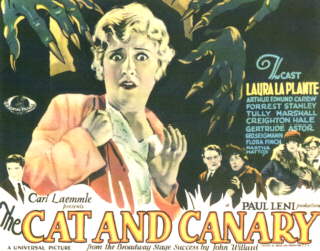
The Cat and the Canary (1927), dir. Paul Leni, Universal Pictures


With this we move into another genre of horror. We’ve seen madmen, vampires, Frankenstein, but now we see a little used aspect of horror: Old Dark House movies. Not the first film to use this setting; that honor would go to 1926’s the Bat, but this is first Universal film to use the aspect and the first Universal Horror film to be remade, a total of five time as of this writing.

We open on a darkened house. The owner, Cyrus West, has finally died after fighting tooth and claw clinging to life. Cyrus, however, hated his family more than he hated dying. Twenty years ago he wrote the particulars in his will to be opened twenty years to the day of his death. The old manor has thus been empty, save for the housekeeper Mammy Pleasant (Martha Mattox) and, according to her, Cyrus’s ghost.

Roger Crosby (Tully Marshall), Cyrus’s lawyer, arrives to go through the paperwork, but while doing so he makes a disturbing discovery. It seems the safe, which the sealed envelopes were kept, has clearly been opened before he arrived.

Before he can delve further into the mystery, Cyrus’s relatives arrive. After seeing them on screen for more than a minute, one can understand why Cyrus wanted to disown them. The last to arrive is Annabelle West (Laura La Plante),a flapper who happens to be Cyrus’s niece. She is also the sole inheritor of his entire fortune and estates, provided she is judged to be of sound mind. Of course, if she is proven to be of unsound mind…then the fortune would go to the next in line…

Not a bad story and the house is almost a more compelling character than some of the characters. The habit of having a comedic relief character show up after anything vaguely scary wears thin fast and this trope will unfortunately be played to near death in the upcoming reviews.

Horro Film countdown 2013, part 5


Dr. Jekyll and Mr. Hyde (1912), dir. Lucius Henderson, Thanhouser Company.


While not the first film adaptation of Robert Louis Stevenson’s famed story, this is the oldest surviving copy. Like other films from the time period, its short running time doesn’t leave much to be discussed. We open with Dr. Jekyll (James Cruze) experimenting in his lab.

The experiment works in a stunning use of special effects, turning the white haired Jekyll into the younger yet monstrous Mr. Hyde (also Cruze, but played in a few scenes by Henry Benham). Jekyll later reverts back to his normal self and continues to woo the local minister’s daughter. From there Jekyll finds himself turning into his hideous alter ego at random, culminating in the murder of his future father-in-law.

Not an awful version, but the Hyde make-up comes across as more goofy than gruesome. Also, and while I can’t talk about the earlier version, this film continues the adaptation habit of giving Dr. Jekyll a love interest, who ends up doing very little in the overall story, but this was a trend that started with the stage productions so it is understandable here. Worth a viewing from a historical perspective, but that’s about all.


Horror Film countdown 2013, part 4


Frankenstein (1910), dir. James Searle Dawley, Edison Manufacturing Company


The first adaptation of Mary Shelly’s famed novel sets the bar. Not very high, mind you, as the film is barely twelve minutes, but it does adhere closer to the story than some of the better known versions. Ignoring Edison’s utter bastardy behavior for the next few minutes, how does the film hold up?
 
Frankenstein (Augustus Phillips), leaves for college and within two years has discovered the secrets behind life and death. He writes to his fiancée Elizabeth (Mary Fuller) boasting that he intends to create the perfect man. What he gets is the misshapen and downright hideous Creature (Charles Ogle). Frankenstein freaks out and the Creature escapes. The Creature, as angered at his appearance as his maker, swears vengeance on his maker.
 
As I said, the film is very short. The special effects are decent for the time period, and the monster looks gruesome even today. The Monster’s motivation plays out a little different as well, focusing on his jealously at his maker. It is worth a viewing at the very least from a historical perspective.


Horror Film countdown 2013, part 3


Wolf Blood (1925), dir. Bruce Mitchell and George Chesebro, Ryan Brothers Production/Lee-Bradford Corporation.


While not the first werewolf film (that would be 1913’s The Werewolf), this is the oldest surviving film where the concept of a werewolf is featured. The supernatural had already been featured in other films mentioned, but this was the another first. We open with the wilds of Canada.

Two lumbering camps are feuding. Dick Bannister (George Chesebro), overseer of the Ford Logging Company, is the bitter rival of Jules Deveroux (Ray Watson) of the Consolidated Lumber Company. Things have progressed that Bannister has been forced to build a clinic on the campgrounds to treat the injuries sustained from the fighting. Despairing, Bannister calls the unseen owner and demands action. The owner, Edith Ford (Marguerite Clayton), is put off by the call but leaves with her fiancĂ© Dr. Horton (Ray Hanford) and uncle (Jack Cosgrove) in tow. Bannister is smitten with Edith, but keeps his distance. While confronting Deveroux and his men in the woods, Bannister is badly injured in the resulting fight. Dr. Horton finds him, and while conducting some impromptu surgery in the cabin of local troublemaker Jacques Lebeq (Millburn Morante), Horton is forced to use the blood of Lebeq’s pet wolf in order to save Bannister’s life.


 Bannister seems to make a full recovery…although soon thereafter the Consolidated Lumber Company is besieged by wolf attacks, culminating in Deveroux being found in the woods, his throat ripped to shreds. Bannister starts acting strange, with blackouts and fits. Could he be behind the killings?


As far as werewolf films go, this is important, but only from a historical perspective. We spend much of the running time focused on the drama behind two logging camps. Unlike the other films mentioned (and the other yet to come), this film plays is safe and makes the horror more psychological rather than physical. Not an awful film, but even with an hour’s running time it seems to last several.


Horror Film countdown 2013, part 2


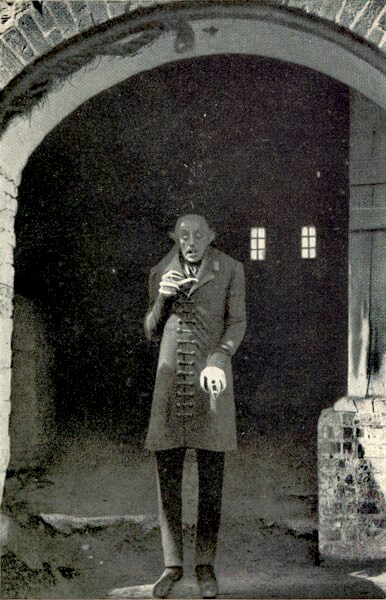
Nosferatu, (1922), dir. F.W. Murnau, Film Arts Guild


Technically not the first vampire film, as that honor would go to the 1921 Hungarian film The Death of Dracula, but this is the oldest surviving one. Directed by the legendary F.W. Murnau, how does the first (semi-legal) adaptation of Bram Stoker’s novel hold up?


Thomas Hutter (Gustav Von Wangenheim), a young real estate agent in the bustling city of Wismar, is tasked to complete a huge sale, one that will bring a great deal of money to his firm and himself. Hutter is hesitant, as the transaction will involve being away from his newlywed wife Nina (Greta Schroeder) and in the barren countryside, but the allure of money is great and soon Thomas is bound for the remote castle of Count Orlock (Max Schreck) deep within the Transylvanian mountains.

Things don’t go as expected. The villagers seem thrown into a panic whenever Thomas mentions his destination or his benefactor. He is left on the side of the road by his coachman. Only the timely arrival from another coach, sent by the Count, keeps him from walking the rest of the way towards the castle.

Once he arrives he meets Orlock in person, and what a person! No pigment, rat like teeth, no hair on his head, dagger like fingernails and claw like hands, Orlock is leagues away from the suave nobleman of later screen versions.

From there the film follows the novel more or less faithfully. There are some differences of course, but as a story it is nearly a perfect version of Dracula. Murnau’s cinematography is breathtaking, with different camera angles and some truly spectacular outdoor shots. Of course, all of this may not have existed if the producers had listened to Stoker’s widow and cancelled the project after they failed to pay her royalties. We should be thankful some prints survived the court ordered destruction. Well worth the effort to track down and see.


Sunday, March 9, 2014

Horror Film countdown 2013, part 1

Had some ideas bouncing around in the old gray matter and I figured I'd share them with anyone who is still reading. As you can tell from the title, this was supposed to be a series that would have run around October 2013. It is a little late. The next review will be the first vampire.


The Phantom of the Opera, dir. Rupert Julian(credited), 1925, Universal Pictures.

2012 was the year of the horror host. So what will 2013 be? How about some of the films featured by said hosts? 2013’s horror countdown will be a series of firsts, what better than the first Universal Monster?


This was the first attempt to translate Gaston Leroux’s 1909 novel to the silver screen. The production was troubled almost from the start, but what made it to the screen was pure gold. We open with the Paris Opera House being sold to two businessmen. Once the deal is completed, the previous owners now feel free to inform the new buyers that there are a few things they should know about the property, namely the Opera Ghost.

The new owners are quick to change their mind about the so-called Phantom when he disappears before their eyes in the number five box. The men are now rethinking their purchase. Meanwhile, up and coming opera singer Christine Daae (Mary Philbin) is having a most curious conversation with a voice that seems to be coming from within the walls of her dressing room. The voice has been giving her singing lessons, it seems, which accounts for her rising popularity. The voice also promises to appear before her as a thing of the flesh and love her as a man.

Christine’s fiancĂ©, the Vicomte Raoul de Chagny (Norman Kerry) is unaware of this, but as it is he is not happy with her career, wishing she would devote less time to singing and more to him. While this is going on, the new owners also have to contend with their current diva, Carlotta (Mary Fabin) and her odious mother (Virginia Pearson), who has been the victim of a several threatening letters. Each letter promises dire fates unless Christine plays the lead in Faust. The promises are delivered on opening night when the massive chandelier is cut by unseen hands and crashes into the audience. Christine is then made the lead, but her tenure is brief as the next day she finally meets her benefactor. The meeting doesn’t go as planned for either party as Christine promptly faints. The stranger, now identified as the Phantom (Lon Chaney Sr.), takes her back to his lair located under the Paris Opera House.

When Christine awakes, she and the Phantom had a chat. It seems the Phantom has plans for Christine, the chief of which is staring in his personal opera, Don Juan Triumphant. Christine, sadly, pulls off his mask and is horrified at what’s underneath. From there things go south for nearly everyone.


How does the Phantom hold up? Fairly well I have to say. All the leads are fantastic, with special attention to Chaney as the Phantom. He’s pathetic, menacing, imposing, and sympathetic in equal measure.  Despite the remakes over the years, I have to say the original still does the story the best. I’d suggest staying with the 1925 version, although the different versions are also decent.